
Introduction
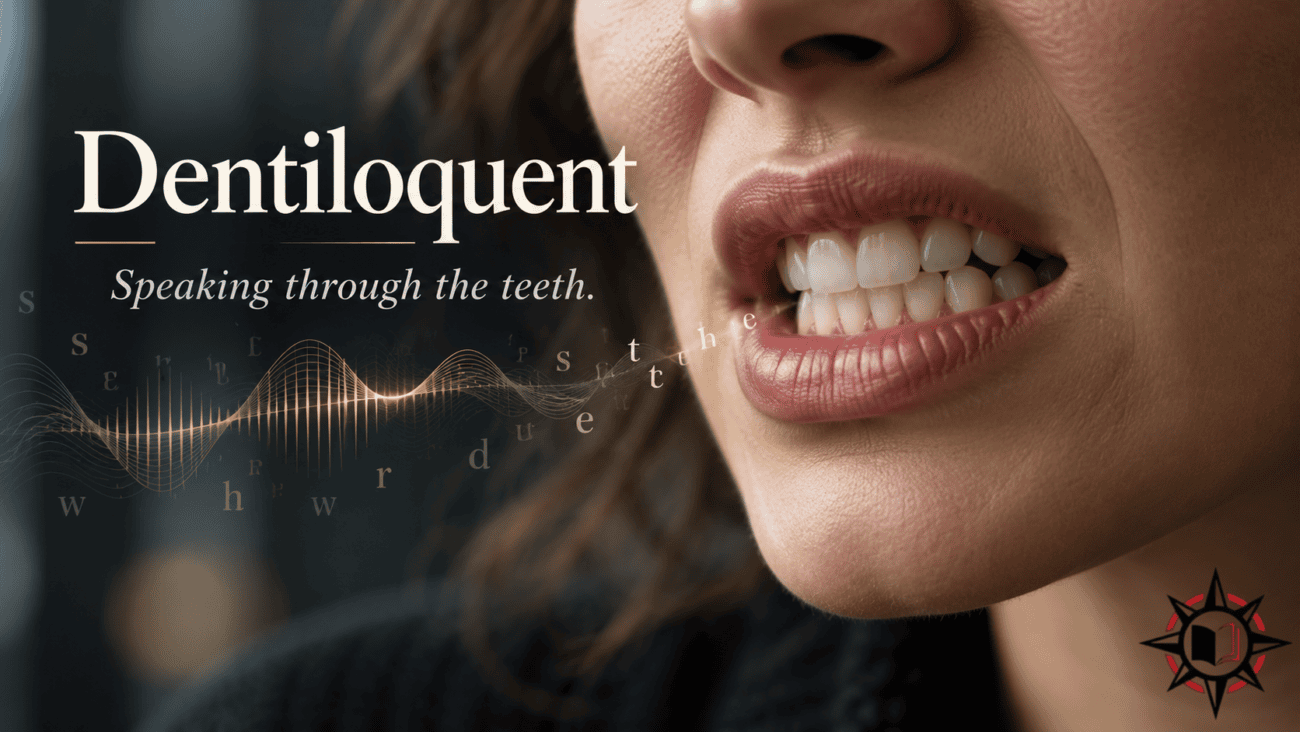
English contains many unusual words that describe specific actions, emotions, and behaviors. Some are commonly used in everyday conversations, while others remain unfamiliar even to people with a strong understanding of the language. Dentiloquent is one such rare word that describes a particular manner of speaking. It refers to someone speaking through their teeth, usually with their jaw held tightly and their mouth only slightly open. Although the term is uncommon, the behavior it describes can be observed in ordinary conversations, films, and theatrical performances.
The word dentiloquent has an interesting connection with the history of English vocabulary and Latin word formation. It combines elements associated with teeth and speaking, giving it a specific meaning. People may speak this way when controlling frustration, expressing tension, or deliberately restricting their mouth movements. Understanding the dentiloquent meaning can help readers recognize unusual vocabulary and describe different speaking styles more accurately. Its history, pronunciation, and examples also make it an interesting subject for language enthusiasts and creative writers.
What Does Dentiloquent Mean?
The dentiloquent definition describes a person who speaks through their teeth or with their teeth held closely together. During ordinary speech, the jaw, lips, and tongue move to produce different sounds. Dentiloquent speech involves limited jaw movement, creating a tighter and sometimes restrained sound. A person may speak this way while trying to remain calm during an uncomfortable conversation. The word describes how speech is physically delivered rather than the actual message being communicated.
For example, imagine someone receiving an irritating comment during a meeting. Instead of responding loudly, the person keeps their jaw tight and answers in a controlled voice. This behavior can be described as dentiloquent. However, the word does not automatically mean that someone is angry. A person might deliberately use this speaking style during a performance or while attempting to speak without moving their mouth noticeably. The important characteristic is the restricted position of the teeth and jaw during speech.
Dentiloquent Pronunciation and Word Origin
The dentiloquent pronunciation can be represented approximately as den-TIL-uh-kwent, with the strongest emphasis on the second syllable. The word may initially appear difficult because it is rarely used in modern conversation. Dividing it into smaller sounds makes pronunciation easier. Dentiloquent functions as an adjective, meaning it describes the manner in which someone speaks. It can be used before nouns such as voice, response, speech, or delivery. The related noun dentiloquy describes the act of speaking through the teeth.
The dentiloquent origin comes from Latin elements associated with teeth and speaking. The Latin word dens, with the related form dentis, means tooth. This root also appears in familiar English words such as dental, dentist, and dentition. The second element comes from loqui, meaning to speak. Similar roots appear in eloquent, colloquy, and soliloquy. Combining these elements produces a word that describes speaking through the teeth. Its structure reflects how English has developed many specialized expressions from Latin vocabulary.
Historical Background of the Word Dentiloquent
Dentiloquent has a documented history extending back several centuries. The word appeared in Thomas Blount’s Glossographia, a dictionary published in 1656. Blount collected unfamiliar and specialized words, often explaining expressions derived from Latin and other languages. His dictionary included vocabulary relating to law, medicine, literature, and different areas of knowledge. The appearance of dentiloquent in this historical reference shows that the term existed long before modern websites began discussing unusual English words.
However, being included in an early dictionary does not necessarily mean that a word was commonly spoken. Historical dictionaries sometimes contained rare or experimental vocabulary that never became part of everyday communication. Linguist Allen Walker Read discussed dentiloquent in research concerning unusual words recorded in dictionaries. The term is therefore interesting not only because of its meaning but also because of its limited historical use. It demonstrates how certain words can survive in reference books for centuries without becoming widely recognized.
How Dentiloquent Speech Works
Human speech depends on coordinated movements involving the tongue, lips, jaw, teeth, and vocal tract. Different speech sounds require different mouth positions. When someone speaks dentiloquently, the jaw remains relatively restricted, and the teeth stay close together. This can affect how certain words sound because the speaker cannot open the mouth as freely as usual. The resulting delivery may appear compressed, tense, or slightly muffled, depending on the person and the sounds being produced.
Dentiloquent speech should not be confused with ordinary dental consonants. In phonetics, dental consonants are individual sounds produced when the tongue touches or approaches the teeth. The English sounds represented by th in words such as think and this are familiar examples. Dentiloquent describes a broader manner of speaking rather than one particular consonant. It is also not a formal medical diagnosis or recognized speech disorder. The word simply identifies an unusual physical style of verbal communication.
Dentiloquent Examples in Everyday Communication
Dentiloquent can be used in descriptive sentences where a person’s physical manner of speaking is important. For example, a writer might say, “His dentiloquent response revealed the tension he was trying to control.” Another sentence could describe a character who answered a difficult question through nearly closed teeth. These examples demonstrate how the adjective can add detail without requiring a lengthy explanation. It helps readers imagine the movement of a character’s mouth and understand the atmosphere of a particular conversation.
The word can also describe situations unrelated to anger. An actor might deliver a dentiloquent line while portraying a secretive character. Someone concentrating on a difficult physical activity may briefly speak with a tightened jaw. In another situation, a person may restrict mouth movement while attempting to communicate quietly. These examples show that dentiloquent is not limited to one emotional condition. Its meaning depends on the physical delivery of speech, while the surrounding circumstances provide emotional context.
Dentiloquent and Other Related English Words
Dentiloquent belongs to a small group of uncommon words connected with speaking. Its closest relative is dentiloquy, a noun describing speech delivered through the teeth. Another historical form is dentiloquist, referring to someone who speaks in this manner. These expressions share similar linguistic roots but serve different grammatical purposes. Dentiloquent describes a characteristic of speech, while dentiloquy identifies the action itself. Understanding these distinctions is useful when exploring rare vocabulary or reading older language references.
Other familiar words involving speech have different meanings. Eloquent describes clear and persuasive communication, while loquacious refers to someone who talks frequently or at length. Soliloquy describes a speech in which a character expresses thoughts aloud, especially in drama. Ventriloquism involves creating the impression that a voice comes from another source. Although these expressions share connections with speaking, they do not mean the same thing as dentiloquent. The word specifically describes speaking through closely held teeth rather than speaking frequently, persuasively, or indirectly.
Dentiloquent in Literature and Creative Writing
Creative writing provides a useful setting for dentiloquent because authors frequently describe facial expressions, body language, and speaking styles. Instead of directly stating that a character feels irritated, a writer may describe the person’s tightened jaw and restrained response. Dentiloquent can communicate this physical detail through a single adjective. It may be particularly effective in scenes involving arguments, difficult conversations, or characters attempting to conceal their emotions. The surrounding context helps readers understand why the character is speaking in that manner.
The word can also be useful in theatre and performance discussions. Actors sometimes adjust their jaw movements, expressions, and vocal delivery to communicate different emotions. A character speaking through nearly closed teeth may appear tense or determined. However, dentiloquent is not the name of a specific professional acting technique. It is a descriptive term that can explain one element of a performance. Writers should also consider whether readers will understand it. In straightforward writing, the familiar expression speaking through clenched teeth may communicate the same idea more clearly.
Common Misunderstandings About Dentiloquent
One common misunderstanding is that dentiloquent means speaking angrily. Although people often tighten their jaws when experiencing frustration, the word itself does not identify a particular emotion. Another misunderstanding involves confusing dentiloquent with the expression lying through your teeth. That phrase refers to deliberately telling a lie, while dentiloquent describes physical speech delivery. Similarly, gritting your teeth can indicate determination or discomfort, but it does not necessarily involve speaking. These expressions should not be treated as interchangeable.
Some readers also assume that dentiloquent is a commonly accepted medical or technical term. In reality, it is a rare vocabulary item with historical documentation and limited modern usage. Collins has recorded it in a word-submission section, reflecting interest in the expression rather than establishing widespread everyday use. Its unusual status does not make it meaningless, but it is important to understand its limitations. For most conversations, speaking through clenched teeth remains the simpler and more recognizable description.
Conclusion
Dentiloquent is a rare English adjective describing someone who speaks through the teeth while keeping the jaw relatively restricted. The word comes from Latin elements meaning tooth and speak, and its historical record reaches back to Thomas Blount’s dictionary published in 1656. Although it is not commonly used in everyday English, it offers a precise way to describe a particular manner of speech. Its related noun, dentiloquy, refers to the action of speaking through the teeth.
Understanding dentiloquent also helps readers recognize the difference between physical speech patterns and the emotions associated with them. The word can be useful in literature, acting discussions, language education, and descriptive writing. However, it should be used where its meaning adds clarity rather than unnecessary complexity. Learning uncommon words such as dentiloquent provides insight into the history of English and the many ways language describes familiar human behavior.
