
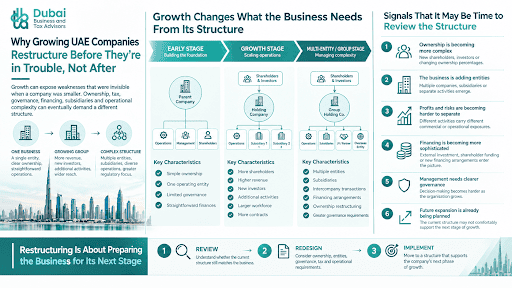
Your business can outgrow its structure
Picture this. A company starts small. One owner. One licence. One bank account. A handful of people.
A few years pass. Now there are multiple activities. A couple of investors. A bigger team. Contracts across different markets.
The business has changed completely. But the structure underneath it hasn’t moved at all. It still looks exactly like it did on day one.
This is where corporate financial advisory services actually help. Not as a fix for a company in trouble. As a way to catch misalignment early, before it becomes expensive. Restructuring doesn’t mean something went wrong. It often just means the business outgrew its original setup.
Your company may be growing faster than its structure
Growth and structural change are two different things. A business can get far more complex without anyone touching the paperwork.
Think about what usually shifts as a company scales. New activities get added. Shareholders come and go. Investors show up. The team spreads into new emirates, sometimes new countries. Valuable IP gets created. Property gets bought. Loans get signed between related companies.
None of that forces a new structure on its own. But here’s the real warning sign: the structure no longer matches how the business actually runs.
Take a consulting firm set up years ago. It might now own valuable IP. It might employ dozens of staff. It might sign major client contracts and hold outside investments. All inside one entity that was only ever meant to invoice for advisory work. That mismatch is where problems start.
What does outgrowing your structure look like?
A few signs tend to show up early.
The licence stops matching the business. The company added mainland-facing work, but kept a Free Zone licence built for something narrower.
Operating activities and ownership blur together. Trading, investments, IP, cash, and daily liabilities all sit inside one entity. Nothing separates what’s at risk from what isn’t.
Outside investors start asking harder questions. They want clean ownership records. They want clear IP rights. They want financial reporting that reflects the real business. Messy governance slows everything down.
Banking gets complicated. Multiple entities. Ownership changes. Stricter KYC checks. Financing that used to be simple suddenly isn’t.
Related-party transactions creep in too. Management fees. Intercompany loans. Shared staff. Each one looks small on its own. Together, they raise questions a tax authority will eventually ask.
Does your company actually need restructuring?
Don’t jump to conclusions yet. Run a quick check first. Ask these questions honestly.
Does the current entity still match what the business does? Are investment and operating activities kept separate? Are valuable assets exposed to operating risk? Have new shareholders joined? Has the company expanded into a new emirate or country? Are intercompany transactions increasing? Are banks or investors asking for clearer numbers?
The answers usually point one of three ways.
Sometimes the structure still works. Growth alone isn’t a reason to change it.
Sometimes only one part needs adjusting. Maybe just how IP is held.
Sometimes a broader restructuring makes sense. Several pieces need redesigning together.
More entities don’t automatically mean a better structure. Sometimes the right answer is to leave things alone.
Why can waiting make things harder later?
This isn’t about scaring anyone into acting today. It’s simpler than that.
As a company matures, it builds up more relationships. Each one adds a layer to untangle later, if the structure ever does change.
More contracts mean more counterparties to notify. More employees mean visa records tied to a specific entity. More financing means loans and guarantees that name that company directly. More assets and IP means ownership gets harder to shift once it’s woven into daily operations.
None of this makes late restructuring wrong. It just means a mature business has more moving parts to coordinate.
What’s the real problem?(Holding company or single entity)
A holding company isn’t automatically the smarter choice. It’s just a tool. The real question isn’t “should I have one?” It’s “what problem would it actually solve?”
| Question | One operating company | Holding structure |
| Administration | Simpler | More licences, more compliance |
| Risk separation | Limited | Assets protected from operating risk |
| Investment readiness | Fine for smaller raises | Often preferred by investors |
| Cost | Lower | Higher, ongoing |
A holding structure can make sense with multiple operating businesses. Or outside investment. Or plans for a future sale. But it can also just add licences and cost with no real benefit. The test is simple. Does the extra entity create enough value to justify running it?
Restructure the existing company, or start fresh?
Reworking the existing entity keeps its history intact. Same contracts. Same banking relationships. But you inherit existing liabilities too, and you’ll need approvals for changes.
Starting a new company gives a clean slate. Clear ownership. Easy separation for a new venture. The tradeoff is real work. New licence. New bank account. Contracts and staff to migrate across.
Neither option wins by default. The right choice depends on the actual problem you’re solving.
What happens to tax when you restructure?
Not every restructuring is tax-neutral. This is where advice matters most.
The UAE’s Corporate Tax framework includes Business Restructuring Relief under Article 27. It can apply when a whole business, or an independent part of one, transfers to another taxable person for shares. Conditions apply. An election is required. There’s a two-year clawback if things unwind too fast.
Transfer pricing needs a look too. Moving functions, assets, or risks between related entities can change how transactions should be priced and documented. VAT deserves its own check as well. It’s easy to focus only on Corporate Tax and forget VAT exists.
The order should always be the same. Design the commercial structure first. Test the tax consequences after.
The financial test that actually matters
Before restructuring anything, weigh the real cost against the real benefit. New licences, extra accounting, audit fees, legal work. It adds up fast.
Set that against what the new structure should deliver. Cleaner ownership. Better investor readiness. Real risk separation. A stronger position before a sale. This is exactly where proper corporate financial advisory services earn their fee. They model the real financial impact before anyone signs a single document.
When you shouldn’t restructure?
Sometimes the right answer is to leave things as they are. Growth alone isn’t a reason to change anything. Neither is a competitor’s holding company, or an org chart that just looks impressive.
If the current structure still fits the business, ownership is straightforward, and banking works without friction, changing it only adds cost. No real value comes with it.
Frequently Asked Questions
How do I know if my UAE company has outgrown its structure?
Check if your licence, ownership and activities still match how the business runs today. If investors, new jurisdictions, or major assets have shown up since setup, it’s worth a review. Growth isn’t the trigger. Mismatch is.
Should a growing UAE business automatically create a holding company?
No. A holding company solves specific problems, like separating risk or preparing for investment. It doesn’t solve growth on its own. Adding one without a clear reason just adds cost and compliance.
Is it better to restructure an existing company or create a new one?
Restructuring keeps your history, contracts and banking relationships. But it carries old liabilities too. A new entity gives a clean start and clearer ownership, at the cost of rebuilding everything from scratch.
Can restructuring trigger UAE Corporate Tax?
It can, depending on the transaction. Business Restructuring Relief under Article 27 may apply to qualifying transfers. Conditions, elections, and a two-year clawback period all need checking first.
Does restructuring affect transfer pricing?
Yes, especially when it shifts functions, assets or risks between related entities. Fees, loans, and shared services may need repricing and fresh documentation. Skipping this step is a common mistake.
Conclusion
A company doesn’t need to be losing money to have a structural problem. It might just have outgrown its old setup. More owners. More assets. More financing. More complexity than the original structure was ever built for.
Reviewing that early isn’t panic. It’s making sure the structure still fits the business you actually run. That’s exactly the kind of review Dubai Business & Tax Advisors (DBTA) works through with growing companies, before small misalignments turn into expensive ones.
READ ALSO: https://elightmag.com
