
A strong pitch deck gets you the meeting. Your numbers decide what happens next. Investors will test how you make money, manage cash, control costs and plan to grow, and they’ll want records that back up every answer.
Many founders without a full-time finance lead turn to CFO outsourcing for strategic support before a raise. This guide covers the questions investors ask, the documents to prepare, the red flags to fix and a timeline to work from.
What Does Financial Due Diligence Mean for UK Founders?
A financial due diligence process will help investors ensure that your numbers back up your story. They will look into your past, present and future.
But an audit will give you assurance around a set scope of your financial statements. Due diligence provides a broader look at your business to help investors decide on a particular deal.
The deeper you get into each round the more scrutiny you will face. Pre-seed investors may want to see your bank statements and basic forecast. By Series A you will need monthly accounts, customer information and a proven financial model.
What Investors Will Ask Your Finance Function?
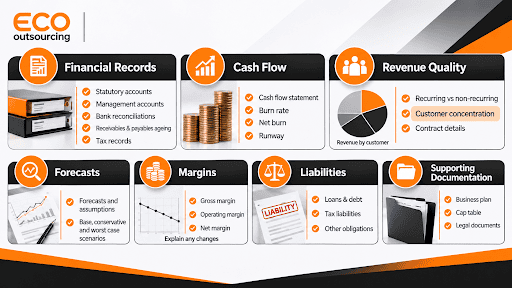
Revenue and Revenue Quality
Investors will want to see how much recurring revenue you have and be able to provide evidence. Bring receipts, contracts and a breakdown of customers.
Recurring revenue (e.g. subscriptions) means you get paid every month. Non-recurring revenue will only come through once. Contracts are also better as they are signed.
For example if you are seeing revenue growth but 60% of revenue comes from one customer, if this customer leaves you will lose a large chunk of business overnight. Investors will question the sustainability of the growth.
Profitability and Gross Margins
Gross margins are your revenue less direct costs involved in delivering them. Investors will want to know why your gross margins fluctuate.
Your revenue may be increasing but if your gross margins have fallen it could be because of increased costs from suppliers.
. Show the cost lines, explain the cause and say whether you can pass the increase on. Profit isn’t cash, so be ready to explain the gap.
Cash Flow, Burn Rate and Runway
Burn rate is the cash leaving your business each month. Net burn is that figure after income. Runway is cash divided by net burn.
Let’s say you have £300k in the bank and £30k net burn, this means you have 10 months of runway assuming your spend remains static. This is rarely the case. A realistic cash runway figure will account for staff hires, when you pay and working capital. It is also good to do a base case and worst case scenario. Investors will ask “what if I take longer to raise?”
Forecasts and Assumptions
Investors will want to know how you got there. If you are projecting 40% growth in revenues you should be able to back it up with your pipeline stats, conversion rates, current contracts and realistic customer acquisition costs.
You should also be prepared to explain why you missed your targets. A good financial projection for start-ups will always include a more conservative lower growth scenario.
Customer Metrics and Unit Economics
These are the cost of acquiring a new customer (CAC), the amount of money they generate over their lifetime (LTV) and retention.
Depending on your business model you will have different metrics. A software business will look at recurring revenue.
A services firm looks at project margins.
Reporting and Internal Controls
Strong financial reporting for startups means monthly management accounts, reconciled bank accounts and figures that match your statutory accounts. If numbers don’t reconcile, find the cause, correct it through proper entries and document what you did.
Tax, Liabilities and UK Compliance
Ensure that you have VAT, PAYE and Corporation Tax up-to-date. Ensure that you are up-to-date with Companies House filings and record Director’s Loans. Maintain documentation to support any SEIS/EIS/R&D claims. Ensure that details are accurate and in line with HMRC guidelines.
Financial Leadership
Who owns the numbers? Who will create and review your forecasts? Investors will want to make decisions based on accurate reports and a finance function which can handle the next stage.
What Financial Documents Should You Create?
Set up your documents in advance. Use clearly named files and have consistent data throughout your investor data room checklist. This will depend on your specific business and funding stage.
| Document | What it shows investors |
| Profit and loss, balance sheet, cash flow statement | Performance, position and liquidity |
| Monthly management accounts | Recent performance |
| Bank reconciliations | Whether records match bank activity |
| Forecasts | Expected performance |
| Customer revenue breakdown | Concentration and dependency |
| Receivables and payables ageing | Who owes you and who you owe |
| Tax records and debt schedule | Obligations and borrowings |
| Cap table | Ownership and dilution |
Financial Red Flags That Delay Fundraising
Weak finances won’t automatically sink a round. Unexplained weaknesses will raise further questions and delay assessments.
Look out for stale documentation, mismatched bank statements, discrepancies between management accounts and statutory accounts, no evidence for forecasts or unexplained changes in margins. Also look out for over dependence on a small number of customers, unclear liabilities, lack of controls and discrepancies between the numbers shown in the pitch deck and what actually happened.
Above all make sure it is clear. Identify the issue, know why its happening, correct any errors and be able to give an evidence based reason.
Never conceal or quietly rewrite figures. Investors will find the gaps.
Getting to Investor-Ready Financials
Behind on your records? Follow these six steps to create your investor ready financials:
- Review Identify gaps in data, inconsistencies and issues
- Reconcile your books. Investigate any anomalies
- Ensure you have accurate management information
- Update your forecasts and cashflow
- Ensure your documents are in order.
This is just a guideline.
| When | What to do |
| 3–6 months before | Review accounts, reconcile records, check compliance |
| 2–3 months before | Update forecasts, review margins, test assumptions |
| 1 month before | Organise the data room and prepare answers |
| During due diligence | Answer questions and explain variances |
| After investment | Track the use of funds and keep reporting |
Outsourced CFO or Full-Time CFO?
You may have a bookkeeper or accountant but still lack strategic oversight. CFO outsourcing can fill that gap without the cost of a permanent hire. It won’t guarantee funding or replace legal, tax or transaction advice.
| Outsourced CFO | Full-time CFO | |
| Structure | External engagement | Permanent employee |
| Cost | Agreed service arrangement | Salary and employment costs |
| Flexibility | Shaped around your needs | Ongoing full-time role |
As an investor you need clear records, understandable performance and realistic projections.
Final Investor Due Diligence Checklist
- Historical financial statements are ready
- Monthly management accounts are current
- Bank accounts are reconciled
- Revenue is backed by records
- Margins and costs are understood
- Burn rate and runway are calculated
- Forecast assumptions are documented
- Risks and liabilities are identified
- Tax and compliance records are organised
- Data-room files are clearly labelled
- Reporting responsibilities are assigned
- You can explain key variances
Frequently Asked Questions
What should an investor be looking for during financial due diligence?
Investors will want to see historical performance, high-quality revenues, good cash flow, profitability, forecast information, liabilities and accurate reporting.
How far back will investors want to see documents?
It really depends on what stage you are at, and how old the company is. At early stage businesses there won’t be much history so the quality of the documents you do have will be key.
Can I raise it with incomplete documentation?
Possibly, however this can increase risk and cause delays. Be transparent about what isn’t complete and what actions you’re taking to rectify this.
Will I need a CFO?
Not necessarily. As the business gets more complicated, having strategic financial leadership will become useful.
How long will it take me to prepare?
Often several months depending on your documentation, reporting and complexity.
Conclusion
Depending on the complexity of your business, whether it is large or small and what reports you need, there are different options available to you. Many growing businesses begin by outsourcing their support and then build up their own internal team.
Finding weak spots early gives you time to fix them. If you want experienced help, CFO outsourcing is a flexible route, and you can explore Eco Outsourcing’s outsourced CFO services when you’re ready.
READ ALSO: https://elightmag.com
